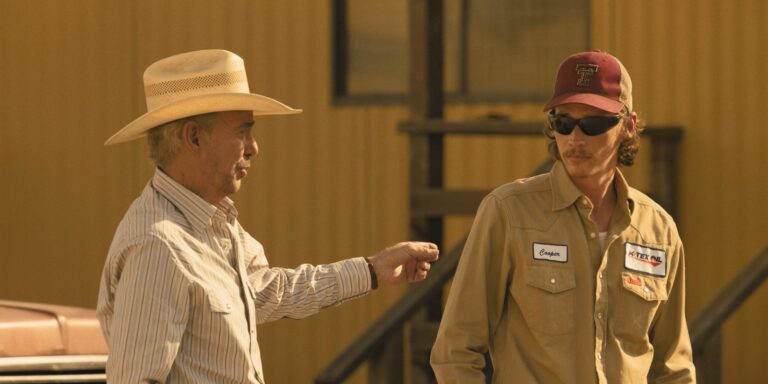


The opening minutes of Landman Season 2 are quiet ones.
No oil trucks explode. No cartel deals go sideways.
Instead, we meet an old man in an assisted‑living facility, fighting bedtime so he can sit outside and watch the West Texas sky.
This is T.L. Norris, played by Sam Elliott. His arrival turns Landman from a two‑generation family story into a three‑generation one. It is a small shift on paper. On screen, it changes the emotional architecture of the series.
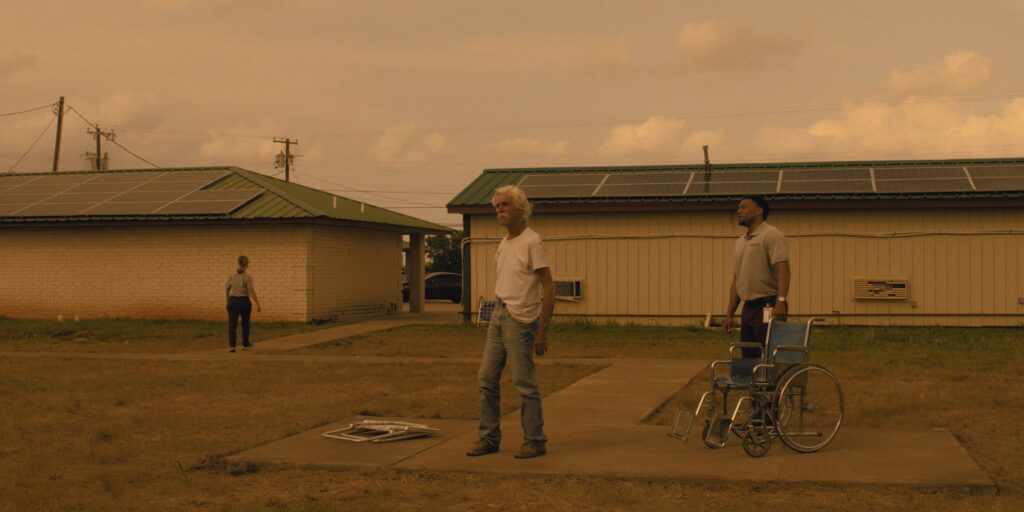
For a show already built on legacy, masculinity, and the long shadow of the oil patch, adding Elliott’s T.L. feels like the missing piece of a puzzle Landman has been building since its November 17, 2024 premiere.
- Landman by the Numbers: Why the Norris Story Matters
- Tommy Norris, Stuck in the Middle
- Cooper Norris: The Next Oil Man in Line
- Ainsley Norris: The Extra Pressure Point
- Enter T.L. Norris: Sam Elliott and the Oldest Generation
- T.L., Tommy, Cooper Norris: Completing the Triangle
- Masculinity, Fatherhood, and the Oil Patch
- Oil’s Multigenerational Impact, From Boomtown to Landman
- What Happens Next for the Three Norrises
Landman by the Numbers: Why the Norris Story Matters
Before digging into the Norrises, it helps to understand the scale of the show they anchor.
Landman, created by Taylor Sheridan and journalist Christian Wallace, debuted on Paramount+ on November 17, 2024, with two episodes released together and weekly installments through January 12, 2025. The series adapts Wallace’s 2019 Texas Monthly podcast Boomtown, which documented the real‑world Permian Basin oil boom and its effects on West Texas communities.
The response has been substantial:
- The series premiere drew about 5.2 million viewers across Paramount+ and its linear preview, according to The Wrap.
- Within its first week, Season 1 reached 14.6 million global multiplatform viewers.
- Over the first four weeks, it hit 14.9 million households globally, which trade coverage reported as the most‑watched Paramount+ original of all time by that metric.
- Nielsen’s U.S. streaming data show 1.3 billion minutes viewed for the week of December 30, 2024 – January 5, 2025, putting Landman third among all streaming programs.
This fall, the series returned in force. Season 2 premiered on November 16, 2025, and according to internal Paramount+ numbers cited by industry reports, the opener generated about 9.2 million global views, or roughly 450.8 million minutes watched. Trade outlets noted it set a new viewing record for a returning Paramount+ original season.
So when Landman chooses to center its story on three generations of the Norris family, it is not just a character choice. It is the emotional framework for one of streaming’s most‑watched dramas.
Tommy Norris, Stuck in the Middle
At the center of that framework sits Tommy Norris, played by Billy Bob Thornton. He is the middle generation, and Season 1 made him the show’s gravitational pull.
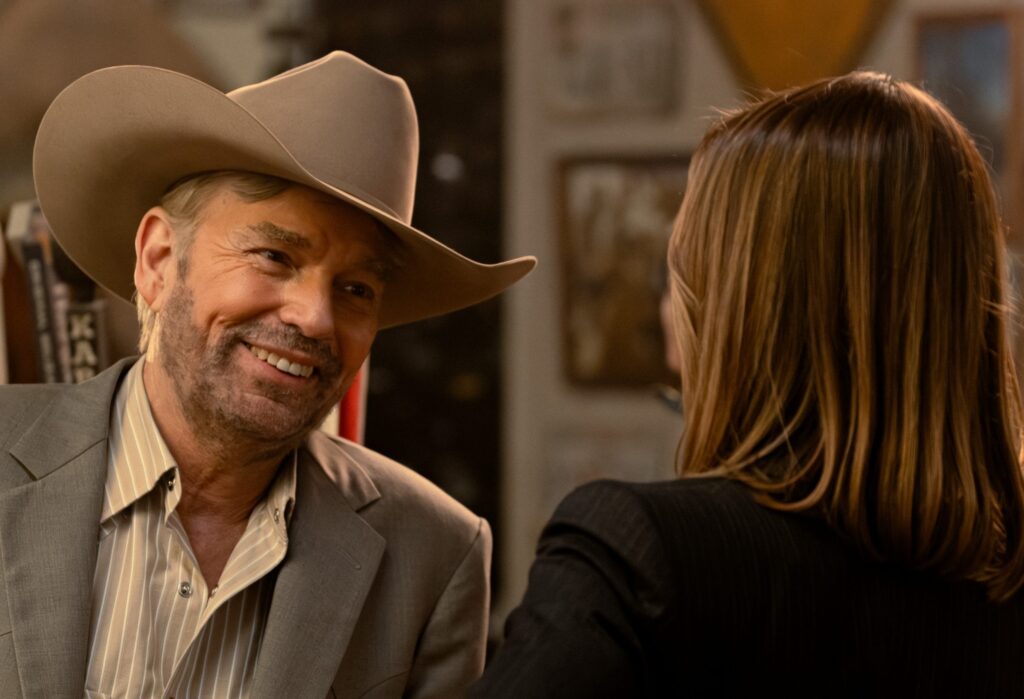
Tommy starts the series as a veteran landman for M‑Tex Oil, working leases and putting out literal and figurative fires in the Permian Basin. By the end of Season 1, he has been beaten nearly to death, watched his boss Monty Miller die of a heart attack, and accepted a promotion that effectively leaves him running M‑Tex.
Season 2 opens with Tommy fully in that new role. In the first episode, he presents to nervous creditors in Fort Worth while facing roughly $500 million in debt service, according to Landman.tv’s recap. He is now the public face of a company carrying enormous debt in a volatile industry.
At home, though, Tommy never stops being a father and ex‑husband. He shares two children with his ex‑wife Angela Norris (Ali Larter): Cooper and Ainsley. Their divorce is established early, but so is their lingering connection.
In the Season 1 finale, Tommy returns home after a brutal attack, confesses to Angela that his life flashed before his eyes and “all [he] saw was [her],” then wakes up the next morning complaining about Ainsley’s boyfriend. As one recap put it, the show refuses to resolve him into either tough cynic or reformed romantic. He is both, often in the same scene.
That tension sits at the center of the show’s portrait of masculinity. Thornton has said he drew on his own experience raising a teenage daughter to play Tommy’s mix of protectiveness and exasperation, especially in scenes with Ainsley. Reviewers at Common Sense Media note that, despite violence and vice, the series repeatedly circles back to family ties and the cost of providing for them in a dangerous business.
Tommy, in other words, is not just an oilman. He is the bridge between the generation that built the patch and the kids now deciding whether to stay in it.
Cooper Norris: The Next Oil Man in Line
If Tommy is the bridge, Cooper Norris is the question mark at the far end of it.
Played by Jacob Lofland, Cooper walks into the series as a young man with other options. He could leave West Texas. Instead, he chooses the rigs. In the pilot, he starts his first day as a roughneck for M‑Tex, where his crew sends him up a tower to look for a fake “Tucker valve.” The hazing nearly ends in serious injury before they relent.
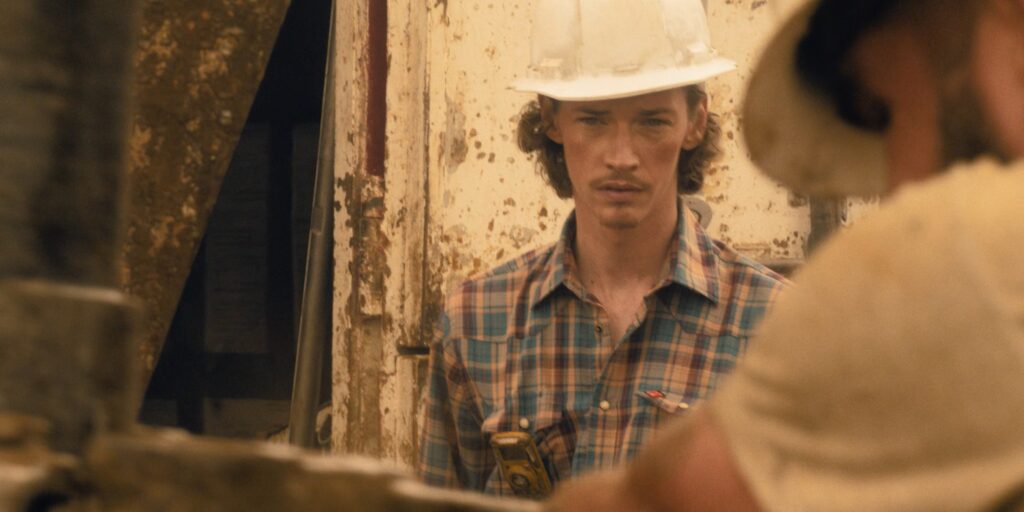
That early sequence sets the tone for Cooper’s relationship with the field. It is dangerous, humiliating, and oddly welcoming once you survive the first test.
Over Season 1, his story deepens. Cooper becomes close to Ariana Medina (Paulina Chávez) after her husband Elvio, one of Cooper’s crewmates, dies in an explosion. The loss pulls Cooper into questions about responsibility and risk that his father has wrestled with for decades.
By the Season 1 finale, he is no longer just a hand on someone else’s rig. He is quietly building his own play. In one scene, he pitches a small landowner on selling a well, explaining that his strategy is to buy up scattered, higher‑royalty producers and “group [them]” into something much bigger. The plan echoes the path many small operators have followed in real Permian booms.
An Esquire recap of the Season 2 premiere notes that Cooper “takes a major role” as the season begins, striking oil and suddenly staring down the possibility of millions. For a series built around generational oil drama, that is a pivotal choice: the youngest Norris moving from worker to would‑be owner.
Reviewers have highlighted Cooper, along with Ainsley, as the embodiment of Landman’s “next generation.” A thematic review at HablemosMoney argues that the Norris kids represent young people caught between family expectations, fast money, and a growing awareness of environmental stakes. When viewers search for “Landman three generations,” it is often Cooper they are asking about next.
Ainsley Norris: The Extra Pressure Point
While this article focuses on T.L., Tommy, and Cooper Norris, Ainsley plays an important supporting role in the family picture.

Michelle Randolph’s performance frames Ainsley as a teenager who loves her father but bristles under his rules. Interviews with Randolph describe how she began to see Thornton as a real father figure on set, a dynamic she credits with improving the authenticity of their scenes.
On screen, Ainsley gives Landman a way to show how oilfield work and its culture filter into high school bedrooms and college decisions, not just boardrooms and rig floors. She may not be in the patch, but the patch is in her life every day.
When we talk about Landman family dynamics Season 2, she remains one of the main people Tommy is trying not to lose.
Enter T.L. Norris: Sam Elliott and the Oldest Generation
Into this already tense setup walks T.L. Norris, played by Sam Elliott.

Paramount+ and trade outlets announced Elliott’s addition on April 29, 2025, confirming he would join Season 2 as a series regular and, crucially, Tommy’s father. The casting reunited Elliott with Taylor Sheridan after their work together on 1883.
On screen, T.L. appears in Season 2, Episode 1, which premiered November 16, 2025. Recaps from Entertainment Weekly, Yahoo, and Primetimer agree on the basics. He lives in a Texas assisted‑living facility. He insists on staying outside to watch the sunset while staff try to usher him in. His wife Dorothy is not there; she is in a separate memory‑care facility.
Then the call comes. Dorothy has died after an afternoon nap.
T.L.’s response tells viewers nearly everything they need to know. He uses dark humor, dismisses sentimental talk about “being reunited,” and suggests their marriage left a lot unsaid. His physical frailty is clear, but so is his stubbornness.
At the end of the episode, the show cross‑cuts between two sunsets. T.L. sits alone outside his facility. Tommy and Angela, miles away, stand in their yard as Tommy tells her, “My mother died.” Landman.tv’s recap emphasizes that visual echo, and critics have been quick to point out what it implies.
First, it ties T.L. directly to Tommy, confirming what publicity already stated: this gruff man is the father who helped shape Tommy’s habits. Second, it places both men under the same blood‑red sky, linked by grief but still apart. That image is the starting point for the Landman three generations structure that Season 2 leans into.
T.L., Tommy, Cooper Norris: Completing the Triangle
With T.L. on screen, the family now spans three distinct stages of life:
- T.L. Norris – an aging father in assisted living, newly widowed and largely estranged from his son.
- Tommy Norris – a beaten‑up landman turned M‑Tex president, juggling half a billion dollars in debt with a fractured home life.
- Cooper Norris – a young roughneck on the brink of becoming a small‑time oil operator in his own right.
This is the core of the “T.L. Tommy Cooper Norris” dynamic that viewers and critics have started to talk about.
Primetimer’s character explainer argues that T.L. places Tommy “in a squeeze” between a hard father above him and kids he does not want to lose below him. The article suggests that understanding T.L. is “essential” to understanding Tommy’s own blend of loyalty, emotional distance, and gallows humor.
Screen‑focused analysis summarized on Landman.tv makes a similar point. The writers describe T.L. as a mirror. His brusque speech, emotional evasiveness, and refusal to go gently into institutional life feel like an older, more brittle version of Tommy’s own traits. Viewers are not told much yet about T.L.’s working life, but the implication is clear. Tommy did not invent his way of being a man in the oil patch. He learned it.
On the other side, Cooper shows what those habits look like one more generation down. He copies Tommy’s work ethic and risk tolerance, but he is stepping into a very different industry landscape. Oil prices are volatile. Debt loads are heavier. Climate politics are louder. When Cooper buys wells and talks about grouping “small producers” into something larger, he is echoing the consolidations that made men like Monty Miller rich, but in a world with far less slack.
Put together, these three Norrises embody what many viewers mean when they call Landman a generational oil drama.
Masculinity, Fatherhood, and the Oil Patch
Landman is not subtle about its vision of masculinity. The show is full of cigarettes, whiskey, and men who treat pain as a scheduling issue, not a medical one.
That posture has not gone unnoticed. An Axios piece on Season 2 points out that the series has arrived during what the American Petroleum Institute calls a moment of “renewed swagger” for U.S. oil and gas. API even launched an ad campaign featuring real landmen during the show’s first run, eager to be associated with its image of rugged workers and resilient industry.
The same article notes that Landman’s most controversial speech so far is an anti‑wind‑power monologue, which sparked online backlash and fact‑checks from clean‑energy advocates. Critics see that scene, and others like it, as part of a broader media conversation about traditional masculinity and energy politics.
Within that context, the Landman family dynamics Season 2 feel especially pointed. Tommy is the kind of father who might be more comfortable negotiating a hostile lease than talking openly about his feelings. Yet he keeps trying. T.L. seems like a man who mostly stopped trying a long time ago. Cooper is deciding which version of manhood to emulate.
Thornton’s comments about drawing on his own parenting experiences add another layer. He and Michelle Randolph have both said that their genuine off‑screen bond made Ainsley and Tommy’s scenes feel more like a real, if messy, father‑daughter relationship. That authenticity grounds the show’s bigger questions about what kind of men the oil patch produces, and at what cost.
Oil’s Multigenerational Impact, From Boomtown to Landman
Landman’s focus on three generations is not an accident. It is baked into the show’s DNA.
The source podcast, Boomtown, chronicled how the 2010s Permian Basin boom reshaped West Texas. Host Christian Wallace grew up in Andrews, Texas, and worked as a roughneck before becoming a reporter. He spent the series documenting everything from rising traffic deaths and sudden ruination of quiet ranch roads to new wealth flowing to landowners and the strains on schools and housing.
The series carries that same sensibility onto the screen. Viewers see college‑bound kids like Cooper leaving other futures behind for a shot at oil money. They meet older ranchers trying to navigate royalty checks and moral qualms. They watch executives like Tommy and Monty Miller weighing safety costs against shareholder demands.
Energy‑industry outlet The Crude Life describes Season 2’s themes as “legacy vs. survival,” listing “family vs. fortune” and “landowner guilt and generational wealth” among the central ideas to watch. It is a tidy summary of what the Norris trio represents.
T.L. embodies the generation that worked, and perhaps prospered, in an era when national conversations about climate and externalities were quieter. Tommy stands in the middle of a storm that now includes cartel money, Wall Street debt, and political scrutiny. Cooper steps into all of that with far less room for error and far more information about what might be coming for the planet.
When you stack them together, the Norrises become a chart of how the oil patch has evolved, and how it keeps echoing inside families even as the business model shifts.
What Happens Next for the Three Norrises
As of late November 2025, Paramount+ is still rolling out Season 2 weekly on Sundays, with the finale scheduled for January 18, 2026. Public reporting on a potential Season 3 remains mixed. Harper’s Bazaar notes there is no official renewal yet, while the Houston Chronicle has suggested a third season is already informally in the works under Sheridan’s broader deal.
Either way, the direction is clear. Landman has moved decisively into three‑generation storytelling.
For viewers, that means a few things to watch as new episodes arrive:
- How often Tommy lets T.L. back into his life, and on what terms.
- Whether Cooper continues down the path from roughneck to operator, and how much of Tommy’s or T.L.’s playbook he follows.
- How Angela and Ainsley respond as the Norris men circle the same oilfield problems from three different life stages.
- How the series continues to tie their personal choices to broader questions about the industry’s future.
Landman started as a story about deals, accidents, and the wild money of the Permian Basin. With Sam Elliott’s T.L. Norris now in the frame alongside Tommy and Cooper, it has become something broader and sharper.
The Landman three generations of Norrises give the show a clearer spine. They turn debates about leases and lateral drilling into arguments about fathers and sons, about what gets passed down and what finally stops.
In a series obsessed with booms and busts, the Norrises remind us that some wells run through families, not rock.