


H2S Gas Leak Ongoing: How Landman’s Jerrell Ends Up Blind, And Why It Rings True
Landman’s second season has never shied away from the rough edges of the oilfield.
But the hydrogen sulfide leak in Episode 3, and Jerrell Teague’s sudden blindness in Episode 4, land differently. They look like TV drama. They read like a case file.
The storyline tracks closely with real hydrogen sulfide, or H₂S, incidents in Texas and across the oil patch. It also lines up, sometimes uncomfortably well, with what doctors and regulators say this gas can do to eyes, lungs, and the brain.
Here is what happens to Jerrell on screen, what H₂S actually does to the human body, and why this fictional accident feels more like a composite of real disasters than a writer’s room invention.
The Leak That Took Jerrell’s Sight
Season 2, Episode 3, titled “Almost a Home,” sets up the entire arc.
A group of hunters wanders near an old oil well and tank after killing feral hogs. One man walks toward the tank, begins coughing, and collapses. The others rush in to help him and drop as well, all inside an invisible gas cloud around the aging equipment. Harper’s Bazaar’s recap describes the sequence as a “deadly hydrogen sulfide gas leak.”
Later, the M‑Tex crew rolls up: Dale, Boss, Ben, Jerrell, and Russ.
Jerrell climbs a tank or silo to get a better view. From that higher perch he spots the bodies scattered around the site. The rest of the crew moves in on foot to check the hunters, unaware that the wind is about to turn on them.
Their personal gas monitors start screaming when that shift comes. Dale and the others begin coughing, retching, and vomiting. They complain of burning eyes, pounding headaches, and trouble breathing as the gas hits. According to the Harper’s Bazaar breakdown, they shout for Jerrell to stay put on top of the tank, because H₂S is heavier than air and tends to hug the ground.
Dale radios in an “H2S leak” and calls for hazmat and EMS. Emergency services dispatch a helicopter to pluck Jerrell off the tank. While they wait, the crew scrambles into hazmat suits and air‑supplied masks. Another sudden gust pushes the gas higher. Jerrell finally gets a full blast, wavers, and collapses on top of the structure before Dale reaches him and seals a mask over his face. Two men, Jerrell and Ben, end up being airlifted to the hospital, while others receive treatment locally and recover more quickly, according to Soap Central’s coverage.
Episode 4, “Dancing Rainbows,” which hit Paramount+ on Sunday, December 7, 2025, shows the aftermath.
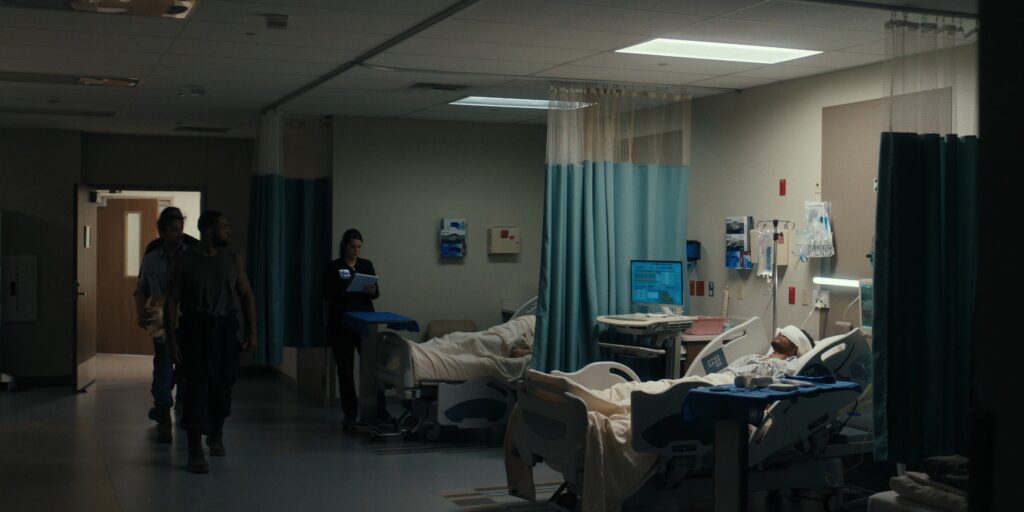
Landman.tv’s own recap notes that Ben is discharged and walking the halls. Jerrell is not.
In that hospital room scene, nurses remove the bandages from his eyes as he waits for good news. Instead, as the recap puts it, his vision “remains stubbornly, chillingly gone.” Realization hits fast. He panics when he understands he still cannot see, thrashing and shouting until Boss and other crew members physically restrain and comfort him.
Our recap describes him plainly as “blind” at this point, and stresses that doctors on the show cannot say if his eyes will ever heal. It frames the moment starkly: “a real man, with a real future, stripped of sight because the oilfield never truly forgives mistakes.”
Outside coverage backs up the severity of what the writers have in mind.
A People magazine explainer describes Jerrell’s vision as “possibly permanently impaired.” A Men’s Health recap calls his injuries “potentially permanent” after a poisoning incident at a drill site. A Yahoo/AOL piece notes that his doctor diagnoses “severe ocular and pulmonary inflammation” after the Episode 3 exposure, and that the medical team cannot yet say if his blindness will lift.
Another analysis goes further, stating that Jerrell may also lose his sense of smell and even normal walking, depending on how much neurological damage the poisoning caused, though that remains uncertain in the story. (BollywoodShaadis summary)
So as of Episode 4, Jerrell is functionally blind.

His eyes are inflamed, his lungs are injured, and his long‑term future is wide open.
The question for many viewers is simple: could this really happen from a single gas hit?
What Hydrogen Sulfide Actually Does to Eyes and Lungs
Hydrogen sulfide is not just “bad air.”
Regulators and doctors treat it as one of the most dangerous industrial gases in the United States.
OSHA calls H₂S “one of the leading causes of workplace gas inhalation deaths” nationwide. Using Bureau of Labor Statistics data, the agency counts 46 worker deaths from hydrogen sulfide between 2011 and 2017 alone. (OSHA H₂S page)
The hazard depends heavily on concentration and time. OSHA’s own tables lay out how fast things can go wrong:
- Around 2 — 5 parts per million (ppm), workers may feel nausea, tearing of the eyes, and headaches. Asthmatics can have breathing issues.
- At 50 — 100 ppm, people can develop conjunctivitis, sometimes called “gas eye,” and significant airway irritation within an hour.
- Between 200 — 300 ppm, eye and airway irritation become “marked,” and pulmonary edema, or fluid in the lungs, becomes a risk.
- At 500 — 700 ppm, collapse can occur within minutes. OSHA warns that “serious damage to the eyes” can develop in about 30 minutes at these levels, with death following in 30 — 60 minutes. (OSHA hazard summary)
NIOSH, the federal occupational health agency, adds more detail. It describes H₂S exposures causing eye irritation, blurred vision, and sensitivity to light, alongside respiratory and nervous system symptoms such as dizziness, confusion, coma, and respiratory paralysis. (NIOSH overview)
Those tables explain why the show’s characters react the way they do.
Coughing, vomiting, burning eyes, and quick collapse at the tank site all match textbook hydrogen sulfide poisoning at high concentrations.
The eye damage question is more specialized, but medical literature is catching up there too.
A 2020 paper in Annals of the New York Academy of Sciences looked at hydrogen sulfide toxicity in human corneal stromal fibroblasts, the main structural cells in the cornea. The authors state directly that contact of H₂S gas with the eye can cause vision loss, and that there is no specific therapy to reverse corneal damage once it has occurred. (PubMed summary)
Occupational physicians have long reported milder “gas eye” cases.
A review in Occupational Medicine notes that lower‑level exposures can cause a keratoconjunctivitis nicknamed exactly that. At higher levels, however, doctors have documented more severe corneal injuries and pulmonary edema. (Occupational Medicine abstract)
The worst accidents also show what happens to survivors.
A case report from China on a 2018 confined‑space H₂S event describes five victims. Three died. One survivor walked away with long‑term neurological damage, including cortical blindness, where the eyes themselves can function but the brain can no longer process visual signals. Only one person recovered fully. (Case report on PubMed)
Another toxicology review of grouped H₂S poisoning accidents documented findings such as conjunctival hemorrhage and corneal erosion in fatal victims. (Toxicology review)
Taken together, those studies say two important things:
1. Eyes are extremely vulnerable to hydrogen sulfide.
2. Survivors can be left with permanent vision problems, either from direct corneal damage or from brain injury during poisoning.
That lines up closely with Jerrell’s fictional diagnosis of “severe ocular and pulmonary inflammation” after what appears on screen to be a high‑dose, short‑term exposure.
Fiction, But Rooted in West Texas History
Landman labels Jerrell’s accident as fiction. The safety details and the broader pattern, however, come straight out of Texas history.
Landman.tv’s own H₂S explainer points to February 2, 1975, near Denver City, Texas. That day, a sour gas well ruptured and released hydrogen sulfide over a residential area. Eight members of the Patton family died trying to flee their home. A responding oilfield worker also succumbed, bringing the toll to nine.
The disaster helped push the Texas Railroad Commission to adopt and later strengthen Statewide Rule 36, which specifically covers hydrogen sulfide safety. The rule requires operators in H₂S areas to test for the gas, post warning signs, train workers, and maintain detailed contingency plans in case something goes wrong. (Rule summary referenced in Landman.tv explainer)
Decades later, the pattern repeated in smaller but no less devastating incidents.
On October 26, 2019, Aghorn Operating employee Jacob Dean went to check on a malfunctioning water pump at a facility in Odessa. Produced water with a high hydrogen sulfide concentration filled the pumphouse and killed him. His wife, Natalee, drove to the site when he stopped answering his phone. She entered the building, inhaled the same gas, and died as well. Their children waited in the car and survived with only slight exposure. (KCRA report)
Federal prosecutors later said safety systems and H₂S alarms at the site were not properly maintained. In April 2025, a federal court fined Aghorn $1 million, contractor Kodiak Roustabout $400,000, and sentenced Aghorn executive Trent Day to five months in prison for negligent endangerment. (San Antonio Express‑News story)
Other cases look eerily like the Landman hunting scene.
In August 2023, three hog hunters from Florida died in a cornfield in Bastrop County, Texas. They climbed into an eight‑foot‑deep uncovered cistern to rescue a dog. Investigators later concluded hydrogen sulfide built up in the cistern from decaying organic matter and possibly dead animals. Each man likely blacked out soon after entry. All three were found dead at the bottom with the dog. (Landman.tv explainer)
Agriculture and wastewater operations have had similar tragedies:
- On August 20, 2024, six workers at Prospect Ranch, a large dairy in Keenesburg, Colorado, died after hydrogen sulfide accumulated in a confined area where manure was decomposing. Victims included a 17‑year‑old and four members of the same extended family. Federal OSHA opened an investigation into the dairy and a contractor. (Incident summarized in Landman.tv H₂S article)
- In 2025, three men working in a manhole at a sewer facility in Trinity County, Texas, died after H₂S built up. Two were employed by H2O Innovation and one by Hydroclear Services. Authorities briefly ordered nearby residents to shelter in place. (Also from Landman.tv explainer)
Even when no one dies, the scale can be startling.
In October 2024, a 100‑foot geyser of wastewater and hydrogen sulfide erupted in Reeves County, Texas. Reporters traced the blowout to a disposal well operated by Apache Corp. about 3.3 miles away. Cleanup and control efforts took weeks. The incident contaminated land and water and led to repeated evacuations when air monitors detected H₂S spikes. (Houston Chronicle investigation)
In response, the Railroad Commission adopted new rules in June 2025 that require operators to map vulnerable wells within a two‑mile radius before certain wastewater injection permits are approved. The same Houston Chronicle reporting noted that the Reeves County blowout would not have been caught by that two‑mile screen, highlighting a gap between the rule and the real hazard footprint. (Follow‑up investigation)
Stack those events next to Landman’s Episode 3.
Dead animals, unsuspecting hunters, a lingering danger around older infrastructure, and workers rushing in with monitors chirping. The show may use fictional names, but the pattern has played out across Texas fields, dairies, and well pads for decades.
An Ongoing Threat in the Permian
The question now is not whether hydrogen sulfide is dangerous. It is who still lives and works in its shadow.
A joint 2024 project by the Houston Chronicle and nonprofit newsroom The Examination mapped more than 54,000 Texas oil and gas wells that have tested for dangerous hydrogen sulfide levels. Reporters estimated that about 78,000 people live within half a mile of those high‑H₂S facilities. (Summary as cited in Landman.tv explainer)
Ambient air monitoring tells a similar story. At two continuous monitoring stations in the Permian Basin, H₂S levels exceeded the state’s 30‑minute ambient air limit of 0.08 ppm a combined 1,590 times between 2020 and early 2024. Regulators often struggled to identify and fix the sources behind repeated spikes. (Houston Chronicle takeaways)
In one Chronicle story, reporters placed mobile monitors on a residential street in Odessa. They documented one‑hour average hydrogen sulfide levels as high as 6,616 parts per billion, with instantaneous peaks near 62,000 ppb. Those readings far exceed Texas’s legal ambient limits, though they do not always reach levels considered immediately life‑threatening. (Odessa street monitoring piece)
Nationally, OSHA and historical analyses show that hydrogen sulfide has remained a steady cause of occupational fatalities. One review Landman.tv cites notes:
- 52 worker deaths from H₂S between 1993 and 1999 in the U.S.
- 80 deaths in 57 incidents from 1984 to 1994, with many victims being would‑be rescuers.
- The 46 deaths between 2011 and 2017 in BLS data summarized by OSHA. (All drawn together in Landman.tv’s H₂S article)
In other words, the danger did not end with Denver City in 1975 or with the Deans in Odessa. Hydrogen sulfide remains part of daily life in the Permian and in other oil and gas regions.
That makes Jerrell’s storyline feel less like a one‑off “movie accident” and more like a composite of the risks thousands of field hands accept every time they step out of the truck.
What Happens Next
For Jerrell, the show leaves that answer open.
As of Episode 4, doctors have diagnosed “severe ocular and pulmonary inflammation,” and Landman.tv’s recap, along with outside outlets, describe him as blind with an uncertain prognosis. Viewers do not yet know whether his sight will return, or whether he will be added to the fictional list of oilfield workers permanently disabled by a bad day at the wrong lease.
Medical literature suggests both outcomes are possible.
Some survivors of acute H₂S poisoning recover much of their function. Others, like the Chinese confined‑space patient with cortical blindness, never regain their vision. The 2020 corneal cell study underlines a sobering point: there is no specific therapy to reverse hydrogen sulfide damage once it has burned through key structures in the eye. (NYAS paper)
Beyond Jerrell, the storyline drops back into a long‑running policy debate in Texas. Statewide Rule 36 and related regulations exist precisely to prevent the kind of surprise that lands him in that hospital bed. They require testing, warning signs, training, and contingency planning in known H₂S areas. Yet investigations by the Houston Chronicle, The Examination, and others show that significant leaks and chronic low‑level emissions still occur in West Texas, and that regulatory responses can lag behind monitoring data.
The show gets at one more practical lesson that shows up again and again in real case files: the people who die or get hurt often are not the first ones in trouble. They are the co‑workers and family members who walk into the same invisible cloud to help. That is what happened to Natalee Dean in Odessa and to would‑be rescuers in past grouped accidents. It is what nearly happens to Dale and the M‑Tex crew before they grab their gear.
As Landman continues its second season, Jerrell’s blindness storyline will likely keep pushing those questions. How much risk do field workers really carry on their backs? Who is responsible when aging infrastructure and sour gas collide? And how many real‑world Jerrells are out there, living with damaged lungs and scarred eyes long after the monitors stop screaming?
For now, the H₂S leak that took his sight may be fictional.
The gas that did it, and the history behind it, are not.